
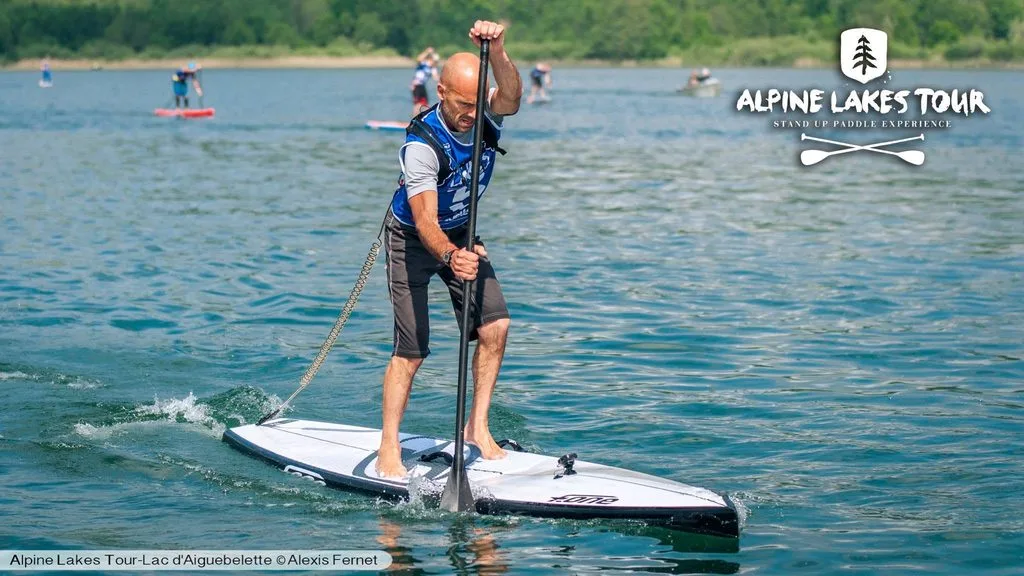
On 17 May 2015, around sixty paddlers gathered on a beach of Lake Aiguebelette for a race that had no name. Eleven editions later, the Very Flat Race has become the final stage of the Alpine Lakes Tour and is run with just a hundred on the start line. The story of a family, of rain, of volunteers, and of a lake we learned to protect.
2015: a race with no name
There was no poster, no logo, not even a proper name. Just one line in the calendar: “Aiguebelette stage of the Alpine Lakes Tour”. The press release of the time simply announced that the circuit was “stopping at Lake Aiguebelette for the very first time”.
Seven days before the start, we were already surprised: “More than 50 entries already for this first edition!” Around sixty would line up that Sunday, 17 May. The long distance covers the full loop of the lake. Exactly the same course as today.
Two brothers crossed the finish line first. Jérémy Teulade won in 1h14′10″. Ludovic Teulade came second, twenty-three seconds back. Nobody knew it yet, but the first line of a ten-year saga had just been written.
A lake protected two months before the first race
The timing is worth telling. In March 2015, the Regional Council classified Lake Aiguebelette as a regional nature reserve. Two months later, the Alpine Lakes Tour held its first race there.
In other words: the Very Flat Race has never known Aiguebelette any other way than protected. Combustion engines are banned — you move across it under sail, under paddle, or on an electric motor. That is exactly what produces the mirror water racers come looking for, and it is also what imposes a strict cap on the field, agreed every year with the reserve managers.
The lake in figures
- 373 metres above sea level
- 545 hectares of surface area
- 71 metres maximum depth
- 166 million cubic metres of water
- Zero combustion-engine boats
Flat Race, then Very Flat Race
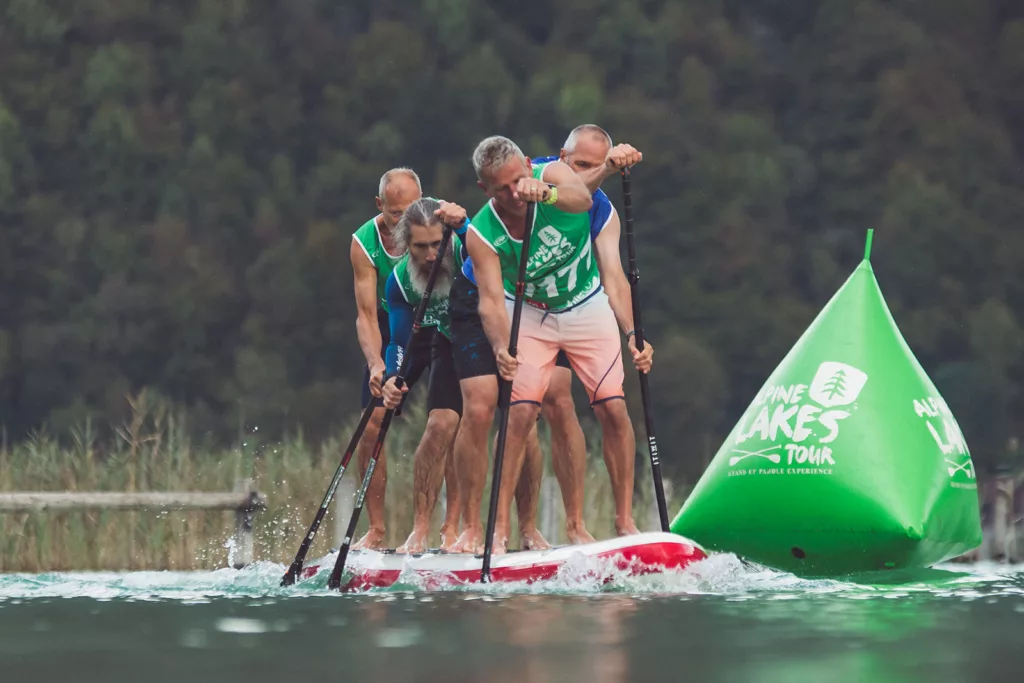
In 2016 the race finally got a name: Flat Race. Ninety-eight entries, and weather that refused to cooperate. The report, still famous internally, was headlined “Rainy flat race, happy flat race”. It thanked paddlers who had come “from Brittany, the Mediterranean, Switzerland, Italy” — the race was already international in its second edition.
That year the Teulade brothers swapped places: Ludovic won in 1h14′30″, with Jérémy four seconds behind. In the women’s 12′6 hard-board category, a certain Edith Teulade took the win. Remember that name — it comes back nine years later.
In 2017 the name settled for good: Very Flat Race. The long-distance course was slightly modified to respect the reserve’s recommendations — reed beds and pile-dwelling sites to go around, thirty metres of clearance from fishermen’s boats, one buoy removed. The race was learning to step aside for the lake.
2018: the line crossed together
On 15 April 2018 the water was 10 degrees and entries had been closed for weeks. Jérémy and Ludovic Teulade crossed the finish line together, in the same time: 1h12′31″. Joint first. You would have to look a long way, in race paddling, for an image that sums up the spirit of an event quite so well.
The following year the race earned the nature and sustainable development sporting event label. It has held it ever since.
2020: the blank year
Scheduled for 7 June, postponed to 1 November, then banned outright. The Very Flat Race is the only edition never to have taken place — cancelled twice in the same year.
When it returned in October 2021, two and a half years after the previous one, something had changed. The race was no longer run in April, in the cold of the end of winter, as the circuit’s second stage. It is now run in October, and it has become the final of the Alpine Lakes Tour circuit: the day the season’s overall ranking is decided. That shift in the calendar, forced by a pandemic, gave the race its present identity.
The volunteer who won the race
2022, seventh edition. Jean-Philippe Dargeou won the long distance in 1h19′48″. He was 58 — and he was also a volunteer that day. He told TotalSUP he had got up “at 4:30 in the morning” to set up the event, then raced, then packed everything away with his mates.
Jean-Philippe Dargeou, 2022 winner, to TotalSUP
That may be the best definition of what a racer comes looking for at Aiguebelette. There are no excuses here: no waves, no wind, no current. All that is left is technique and legs.
A family race
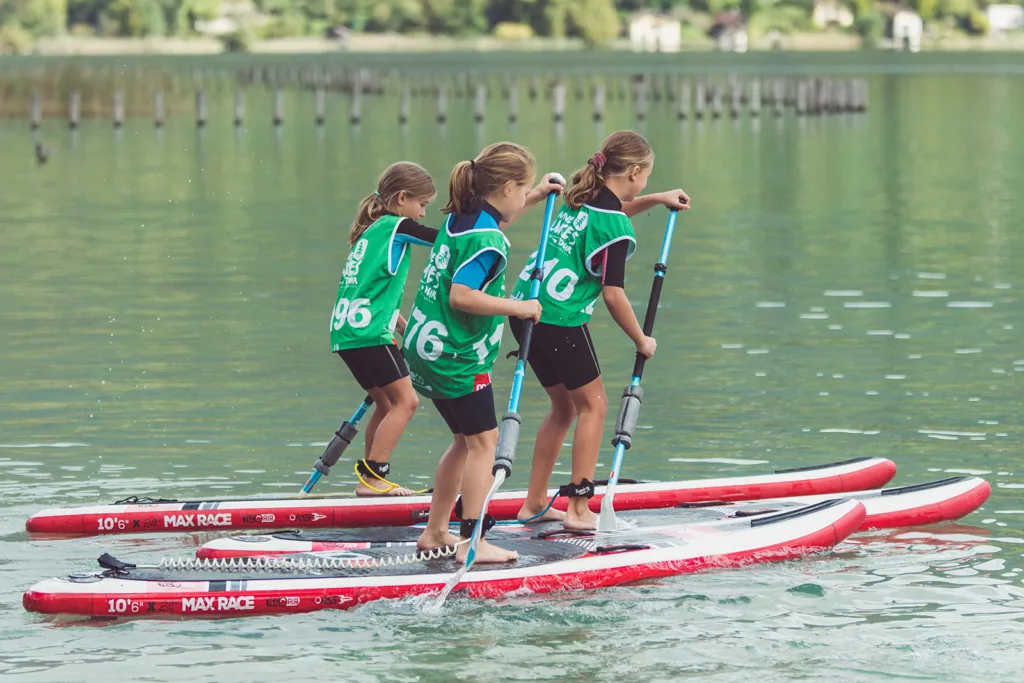
In 2024, ninth edition, one hundred participants, six nationalities. On the short distance, Maya Jalmain, aged 12, finished second in 43′23″. On the long distance the same day, Sébastien Jalmain — her father — finished second, three seconds behind Ludovic Teulade.
And in 2025 the loop closed: Ludovic Teulade won for the second year running, faster than the year before (1h11′48″ against 1h12′03″). In the women’s race, Edith Teulade took the win. Ten years after the first edition, the same names, the same family.
The loyalties
A race is not only a roll of honour. In 2025 the organisers thanked Red Paddle Co, a partner “for 10 years”, the managers of the Lake Aiguebelette Reserve who grant the authorisation “for 10 years as well”, and a photographer present “for 11 years” — that is, since before the first Very Flat Race.
Eleven editions, and roughly the same people around the start line. That is probably the real achievement.
The roll of honour, edition by edition
| Ed. | Date | Long distance — men | Long distance — women | Archives |
|---|---|---|---|---|
| 1st | 17 May 2015 | Jérémy Teulade — 1h14′10″ | Susanne Lier — 1h24′08″ | 2015 results |
| 2nd | 17 April 2016 | Ludovic Teulade — 1h14′30″ | Sigrid Baumgartner — 1h34′08″ | 2016 results |
| 3rd | 8 April 2017 | Jérémy Teulade | Sigrid Baumgartner | 2017 results |
| 4th | 15 April 2018 | J. & L. Teulade — 1h12′31″ (joint first) | Marie Dautruche | 2018 report |
| 5th | 14 April 2019 | Ludovic Teulade — 1h04′42″ | Siri Schubert — 1h13′58″ | 2019 results |
| — | 2020 | Cancelled twice | Cancelled twice | 2020 cancellation |
| 6th | 10 October 2021 | Clément Savin — 1h13′40″ | Emmanuelle Marcon — 1h22′18″ | 2021 results |
| 7th | 2 October 2022 | Jean-Philippe Dargeou — 1h19′48″ | — | 2022 results |
| 8th | 8 October 2023 | Olivier Comazzi — 1h12′40″ | Florence Julen — 1h20′13″ | 2023 results |
| 9th | 6 October 2024 | Ludovic Teulade — 1h12′03″ | Emmanuelle Marcon — 1h20′27″ | 2024 results |
| 10th | 5 October 2025 | Ludovic Teulade — 1h11′48″ | Edith Teulade — 1h27′12″ | 2025 results |
| 11th | 4 October 2026 | To be written | To be written | — |
Long-distance lengths have varied across editions, notably to adapt to the constraints of the nature reserve. Times are therefore not comparable from one year to the next, with the exception of 2024 and 2025, raced on the same course.
The eleventh
On Sunday 4 October 2026, the Very Flat Race will put a hundred paddlers back on the flattest water in Europe, for the eleventh time. Common start at 10:00 am: long distance 11.5 km and short distance 4.5 km. Kids Race, lunch by the lake, and the prize giving at 4:30 pm — where the 2026 Alpine Lakes Tour overall ranking will be announced.
A hundred places, not one more: that is the condition set by the reserve. On the one lake in the Alps where the water does not move, they do not stay available for long.
🚨 Registration is open
100 places · Long Distance 11.5 km · Short Distance 4.5 km · Kids Race
Sunday 4 October 2026 — Lake Aiguebelette, Savoie, France